
What Is a Skill?
In the time it takes to read this sentence, ten people were hired in the US.1 Each was picked from a mountain of resumes that were likely first screened by AI.
In an ideal world, every one of these resumes would be delivered to the perfect recruiter, read line by line and thoughtfully considered.
This is not the case.
There are far too many resumes and far too few recruiters. Parsing, algorithms and AI are a necessary crutch of the modern job market, required to answer many difficult questions about a person very quickly. One of these questions is "what skills does this person have?"
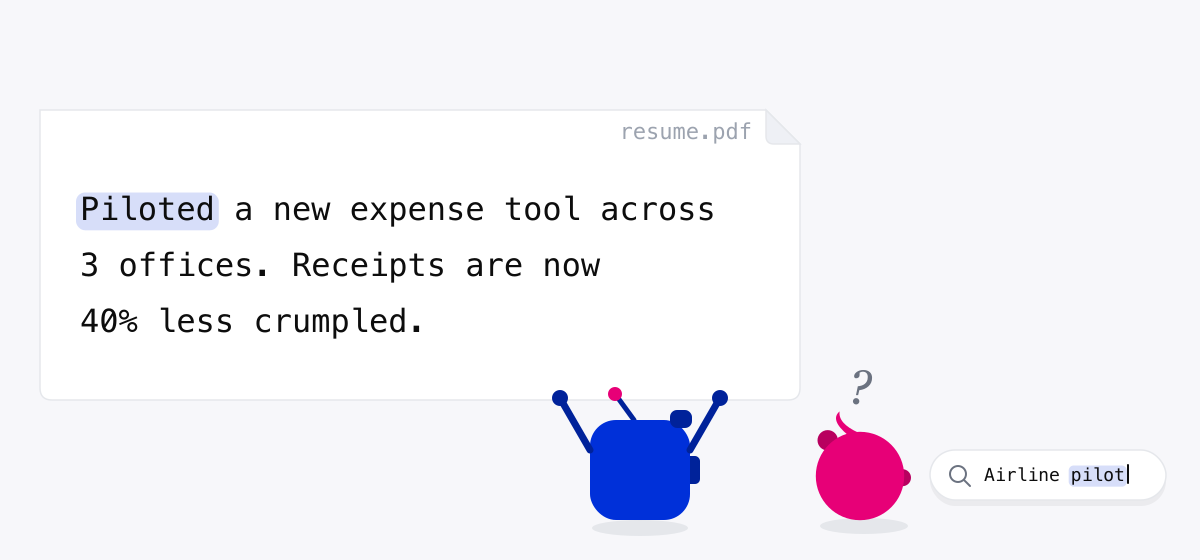
Getting an AI model to extract skills from a single resume is relatively simple. Extracting and comparing the skills from every person to every job is difficult; people describe the same work in a number of very different ways.
Take the skill "Microsoft Excel".
Some people name it exactly. Some write "Microsoft Office." Some list it at the bottom of the page next to "teamwork" and "a can-do attitude." Some never mention it at all: an analyst who "built monthly revenue forecasts using pivot tables and VLOOKUPs" is clearly skilled, but does not spell this out.
There is also the question of what granularity and what context we should extract around each skill. Take the phrase "Drew blood for lab work in a busy ER." Is the skill phlebotomy, lab work or emergency medicine? If we prompt the AI to pick the most specific skill, it returns "phlebotomy," and a search for emergency medicine never finds this person. If we tell it to pick the broad category, it returns "emergency medicine," and the phlebotomist looks like every other nurse and tech on the floor. If we tell it to extract all three, the skills list grows so long that the recruiter is back to reading the resume, but chopped into little pieces.
One quickly finds themself in an infinite loop of prompt adjustments even for a single skill. There are billions of skills, job titles and companies which need to be accurately determined.
A golden dataset
Without a baseline to measure how each prompt change affects a large sample of candidates, we are flying blind.
A golden dataset cures the compulsion to overfit. When someone writes a resume so unique that the model misses it and we add another rule to the prompt, we rerun this new prompt against the golden dataset and highlight the cost of this adjustment: one change to the model's instructions has broken twenty other profiles.
A golden dataset forces the discipline to say, "We are not making the prompt more fragile to save one candidate who decided to describe data analysis as 'digital storytelling with numbers.'" This is the unfortunate but necessary sacrifice.
The process of building a golden dataset also tends to expose the fact that people aren't much better at deciding what a skill is than machines. Hand the same five resumes to five recruiters and you will get five conflicting opinions on what skills are present, and what counts as a skill. There is no objective baseline, there is only the aggregated assumptions of many different people trying to explain a very fuzzy label. An AI model then becomes the sixth confused recruiter to join the party.
A model is an unusual recruiter to argue with. It never gets tired, it makes the same call on every resume in a similar way every time, and you can mold it. This makes many disagreements with your golden dataset a reflection of your ability to write clear instructions and your own notion of what a skill is.
The model tags SQL on someone who "partnered with database analysts". You side with the recruiter and tighten the prompt.
The model catches "wrote SQL queries for the finance team" on page two of a resume the recruiter skimmed at 4:55 on a Friday. You side with the model and fix the golden set.
The model tags SQL on someone who "ran the daily SQL reports". The recruiter rejects it: pressing run on someone else's query isn't knowing SQL. This rule lived in the recruiter's head until the AI model challenged it. Is this a sensible rule?
A label will never be objective, but it can be consistent, and one disagreement at a time, one wrestles with the model to make the label of "skill" more precise.
Do we need labels?
Consider for example the proceedings that we call 'games'. I mean board-games, card-games, ball-games, Olympic games, and so on. What is common to them all? If you look at them you will not see something that is common to all.2
Take a recruiter search for a nursing position:
"RN, 2 yrs acute care, BLS/ACLS, telemetry preferred."
Each phrase hides a decision. Does a step-down unit count as acute care? Is ACLS a skill or a certification? Is telemetry a skill, or the unit where someone built their skills?
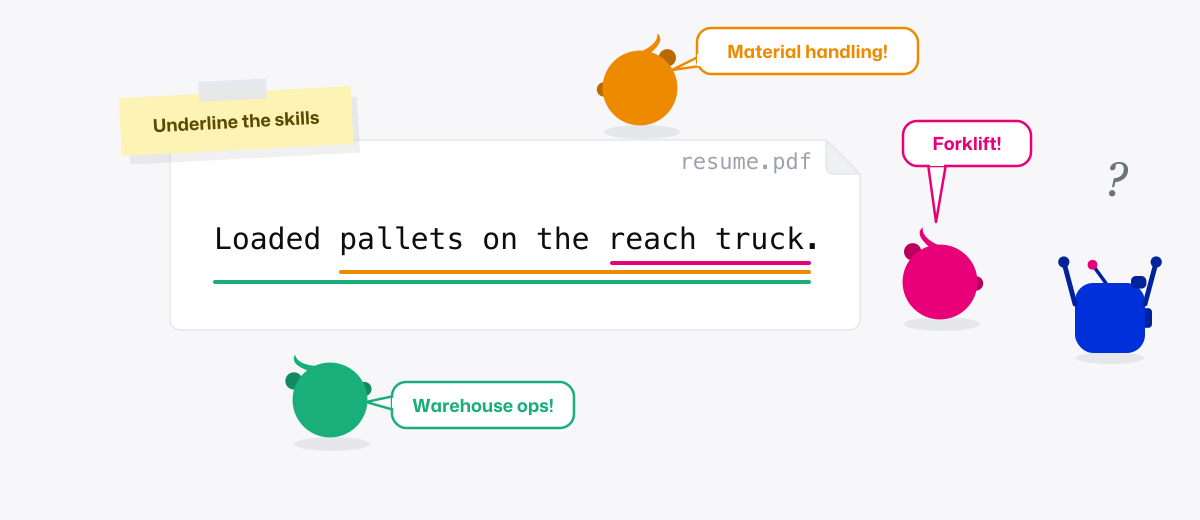
Skills are not self-contained units of meaning. A resume that mentions "P&L" might belong to a finance director who owned a hundred-million-dollar operating budget, or an intern who prepared the slides for a quarterly review. Labels constantly bleed into one another. "Epic" is enterprise hospital software, but it is also an ordinary adjective. "CDL-A" is a government license, a regulatory compliance standard, and a de facto job title all at once.
There is no single feature shared by all the things we label "skill". Driving a forklift, speaking Spanish, building a pivot table, calming down an angry customer and holding a commercial driver's license are qualities too unique to be forced into a single label.
We have been obsessed with skills and labels because for thirty years, database architecture has given no alternative. Recruiters picked keywords, learned Boolean operators, and candidates learned to paste these keywords into their resumes, so that the system would match the two together. The algorithm rewarded applicants who learned the dialect of the search engine and shut out people who describe their work in plain language.
As language models have arrived with the ability to understand context, we have continued to ask them the same label-based requests. The market has taken a tool capable of holistic context and forced it to populate the exact same general, oblique boxes we've been using for fifty years: job title, skill, industry, etc.
We are also stuck with labels because they are simple to explain to an auditor. Compliance, reporting, and payroll all run on discrete fields. Regulators and courts do not accept latent embeddings or model weights as evidence of fair hiring; they demand labels which have been statistically tested to avoid adverse impact.
Models that understand language can read a work history the way an experienced recruiter does. Reading like a recruiter is not the same as reading fairly. Where should regulation sit on the explainability of a person versus a model's decisions? Who is more of a black box? For fifty years the system has lost people who didn't fit arbitrary labels, or a weary recruiter who tossed someone at 4:55 on a Friday. There is a future where AI can, if we hold it to the standard of the most thoughtful and studious recruiter, be the reader with enough energy and time to give every person and every resume a fair judgement.
Sources
- U.S. Bureau of Labor Statistics. Job Openings and Labor Turnover Survey: 63.0 million hires in 2025. 2026.
- Wittgenstein, L. Philosophical Investigations, §66. Trans. G. E. M. Anscombe. Blackwell. 1953.
- Furnas, G. W., Landauer, T. K., Gomez, L. M., & Dumais, S. T. The vocabulary problem in human-system communication. Communications of the ACM, 30(11), 964–971. 1987.